METHODOLOGY FOR BUYERS

How were buyers assessed?
The 2026 edition of the Palm Oil Buyers Scorecard (POBS) assesses 191 manufacturers, brands, and retailers across Europe, North America, Asia, and Australia on their commitments and actions related to sustainable palm oil.
The Scorecard measures the key actions that companies are taking to source and support sustainable palm oil, with an emphasis on deforestation, conversion, and human rights. The Scorecard is divided into three sections:
Set goals - Commitment by companies to ensure that their palm oil supply is sustainable and free from deforestation, natural ecosystem conversion, and human rights violations.
Take action - Supporting actions by companies to meet their sustainability goals.
Industry change - Actions taken by companies to promote sustainable palm oil beyond their supply chain, contributing to wider industry transformation.
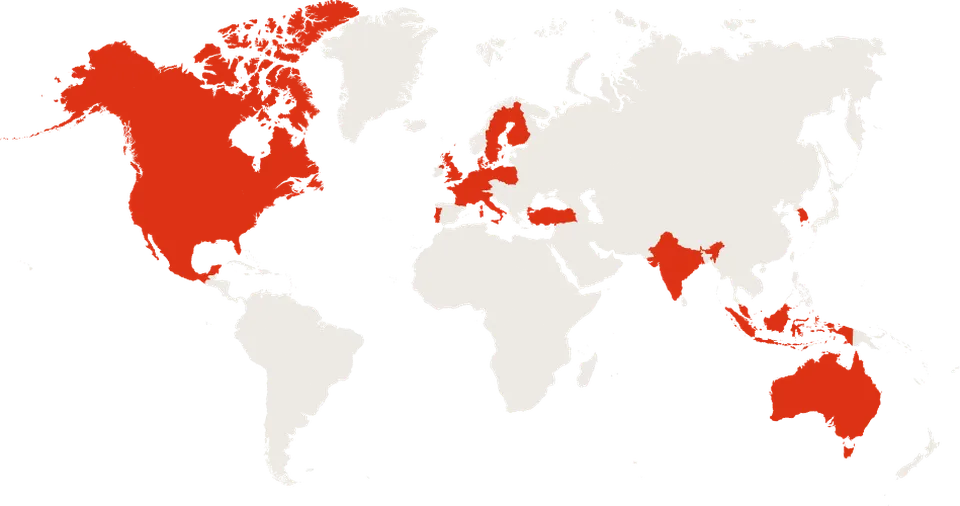
- 25companies assessed in North AmericaUnited States
- 129companies assessed in EuropeBelgium, Denmark, Finland, France, Germany, Italy, Netherlands, Poland, Portugal, Sweden, Switzerland, United Kingdom
- 31companies assessed in AsiaIndia, Indonesia, Singapore, South Korea
- 6companies assessed in AustraliaAustralia
- 191Number of companies assessed
- 135Manufacturers assessed
- 49Retailers assessed
- 7Feed companies assessed
WHAT DATA DID WE COLECT?
It is important to note that the questions are not exhaustive of the actions that companies can take to support sustainable palm oil, but represent some key areas identified by WWF, including embracing the RSPO standard (P&C 2024) and efforts to address deforestation, conversion and human rights issues in the palm oil sector.
For more detailed guidance, WWF encourages companies to refer to the Accountability Framework as a comprehensive set of common norms and guidance for establishing, implementing, and demonstrating progress on ethical supply chain commitments in agriculture and forestry.
Scoring criteria
Set goals5 points
Commitments5 points
2.5 points
Does your company have a commitment to purchasing palm oil that is free from deforestation and conversion?
Whether a company has a commitment to purchasing palm oil that is free from deforestation and conversion
Commitment
0.5 points if the commitment is deforestation-free but does not meet the Accountability Framework definition for conversion*-free
1 point if the company has a no deforestation and no conversion commitment that meets the Accountability Framework definitions
*Conversion is a change of a natural ecosystem to another land use or profound change in a natural ecosystem’s species composition, structure, or function. Deforestation is one form of conversion (the conversion of natural forests).
Scope
0.5 points if the commitment covers the entire company/corporate group (including all volumes and palm oil types)
Target & Cut-off date
0.5 points if the commitment includes a target date for achieving 100% deforestation- and/or conversion-free no later than 2030. Target dates later than 2030 receive no points.
0.5 points if the commitment includes a cut-off date of 31st December 2020 or earlier for its deforestation- and/or conversion-free commitment
1.5 points
Does your company have a commitment to purchasing palm oil that respects human rights?
Whether a company has a commitment to purchasing palm oil that respects human rights
Commitment
0.5 points if human rights commitment does not cover the rights of all relevant stakeholder* groups or only partially meets the Accountability Framework’s definitions and requirements
1 point if human rights commitment covers the rights of all relevant stakeholder groups* and meets all of the Accountability Framework’s definitions and requirements
*stakeholder groups includes workers, indigenous people, local communities, and others who may be impacted by company activities
Scope
0.5 points if the commitment covers the entire company/corporate group (including all volumes and palm oil types)
1 point
Does your company have a commitment to purchasing 100% RSPO certified sustainable palm oil (CSPO)?
0.5 points for making a public commitment to buy 100% RSPO CSPO
0.5 points for making a time bound commitment to achieve this by 2025* (or if already achieved)
Take action14 points
Purchasing sustainable palm oil11 points
10 points
How much of your palm oil purchasing is sustainably sourced?
This indicator assesses the credibility and robustness of a company’s palm oil purchasing practices by evaluating:
The types of RSPO supply chain models used; and
Whether non-RSPO IP and SG volumes are covered by credible due diligence and verification.
This indicator recognizes RSPO certification as a baseline expectation, while allowing companies to demonstrate sourcing that is deforestation- and conversion-free, and respects human rights through other credible due diligence and verification systems.
For retailers, third-party products containing palm oil are excluded.
Steps for companies with HQs in Australia, Europe, or North America:
1. Scoring based on RSPO supply chain model
Companies receive base points based on the percentage of total palm oil volumes sourced under different RSPO supply chain models.
Scores are weighted by the percentage of total palm oil volumes that fall under each supply chain model.
2. Additional due diligence for non-RSPO IP and SG volumes
Companies received additional points for MB, ISH credits, B&C, or uncertified volumes that are covered by credible due diligence and verification systems.
To qualify, companies must demonstrate the following:
DCF and human rights commitment: The company has AFi-aligned commitments covering deforestation, conversion of natural ecosystems, and human rights, including a cut-off date no later than 31 December 2020.
Supplier requirements: The company requires suppliers to have equivalent DCF and human rights commitments covering their sourcing.
Monitoring systems: The company has monitoring systems for DCF and human rights that align with AFi.
Traceability: The relevant volumes are traceable to plantation, unless the company provides credible evidence that traceability to plantation (TTP) is not required to determine compliance, for example through risk assessment, sourcing from low-risk areas, or supplier control systems.
Transparency: The company publicly discloses relevant supply chain data.
Grievance and remedy: The company has publicly accessible grievance and remedy mechanisms.
Independent verification: The company's claims are independently verified by a credible third-party.
Companies were required to provide comprehensive supporting evidence to qualify for enhanced scoring. Otherwise, base scores for RSPO supply chain models applied.
The final score is the sum of weighted scores, capped at 9 points.
Steps for companies headquartered in Asia:
1. Scoring based on RSPO supply chain model
Companies receive points based on their total RSPO uptake, regardless of which supply chain model they use.
Scores were weighted by the percentage of total palm oil volumes that fall under each category.
2. Additional due diligence for uncertified volumes
Companies received additional points for uncertified volumes that are covered by credible due diligence and verification systems.
Companies were required to provide comprehensive supporting evidence to qualify for enhanced scoring. Otherwise, base scores for RSPO supply chain models applied.
The final score is the sum of weighted scores, capped at 9 points.
For all companies (regardless of location of headquarters):
3. One point for 100% RSPO CSPO
Companies receive +1 additional point if 100% of palm oil volumes are covered by RSPO CSPO, regardless of supply chain model.
Companies with HQs in Australia, Europe, or North America
Base score (multiplier) by RSPO supply chain model
9 points for IP and SG volumes
3 points for MB volumes
2 points for ISH credits
0 points for B&C and uncertified volumes
Enhanced score (multiplier) for volumes covered by credible due diligence and verification systems:
9 points for IP and SG volumes
7 points for MB volumes
5 points for ISH credits
5 points for B&C and uncertified volumes
Final score: sum of weighted scores across categories, capped at 9 points
Companies headquartered in Asia
Base score (multiplier)
9 points for RSPO certified volumes
0 points for uncertified volumes
Enhanced score (multiplier) for volumes covered by credible due diligence and verification systems:
9 points for RSPO volumes
5 points for uncertified volumes
Final score: sum of weighted scores across categories, capped at 9 points
All companies
+1 additional point if 100% of palm oil volumes are covered by RSPO CSPO
1 point
Do the above quantities cover all palm oil types purchased across the entire company or corporate group?
1 point if the reported quantities relate to all countries in which the group operates (or all countries in which the company operates, if company is not part of a group)
0.5 points if the reported quantities relate to all the countries in which the company operates but do not relate to all countries in which the group operates (note: this option only applies if the company is part of a group)
0 points if the reported quantities do not relate to all countries in which the company operates
Suppliers requirements2 points
0.5 points
Does your company expect its suppliers to purchase only palm oil that is free from deforestation and conversion?
Whether a company’s suppliers are expected to have a commitment to purchasing palm oil that is free from deforestation and conversion
0.5 points if your company expects its suppliers to have a no deforestation and no conversion commitment that meets the Accountability Framework definitions
0.25 points if your company expects its suppliers to have a deforestation-free commitment, but does not specify that the commitment should meet the Accountability Framework definition for conversion*-free
*Conversion is a change of a natural ecosystem to another land use or profound change in a natural ecosystem’s species composition, structure, or function. Deforestation is one form of conversion (the conversion of natural forests).
0.5 points
Does your company expect its suppliers to purchase only palm oil that respects human rights?
Whether a company’s suppliers are expected to have a commitment to purchasing palm oil that respects human rights
0.5 points if your company expects its suppliers to have a human rights commitment that covers the rights of all relevant stakeholder groups* and meets all of the Accountability Framework’s definitions and requirements
0.25 points if if human rights commitment does not cover the rights of all relevant stakeholder groups or only partially meets the Accountability Framework’s definitions and requirements
*stakeholder groups includes workers, indigenous people, local communities, and others who may be impacted by company activities
1 point
Does your company monitor its suppliers for compliance with its policies and commitments?
Whether a company monitors suppliers for compliance with its policies and commitments
Deforestation and conversion monitoring
0.5 points if the company’s DCF monitoring and response system aligns with the Accountability Framework
0.25 points if the company has monitoring and response systems in place to monitor supplier compliance with its deforestation- and/or conversion-free commitments but does not meet the requirements under Core Principle 11 of the Accountability Framework
Human rights monitoring
0.5 points if the company’s human rights monitoring and response system aligns with the Accountability Framework
0.25 points if the company has monitoring and response systems in place to monitor supplier compliance with its human rights commitments but does not meet the requirements under Core Principle 11 of the Accountability Framework
Traceability1 point
1 point
Does your company have a monitoring system to measure traceability of palm oil purchased to the mill or plantation?
Whether the company has a monitoring system to measure traceability of palm oil purchased
This indicator assesses a company’s progress on achieving traceability to plantation (TTP) and/or mill (TTM).
TTP scoring
% total volumes TTP * 1 pointTTM scoring
% total volumes TTM * 0.5 points
Note: If both TTP and TTM are reported, the company’s score is calculated as the higher of the two scores (points are not stacked).
Unscored
Does your company have a monitoring system and policy to measure traceability of palm oil purchased?
Note: Companies do not get scored on answering “yes” or “no” for merely having a monitoring system in place for traceability.
Industry transformation6 points
Sustainable palm oil platforms2 points
2 points
Is your company a member of one or more action-oriented sustainable palm oil platforms?
Membership in action-oriented sustainable palm oil platforms and performance in RSPO Shared Responsibility scorecard
0.5 points for being an RSPO member
1 point awarded on a linear, proportional basis according to a company’s score in the 2026 RSPO Shared Responsibility (SR) scorecard, calculated as follows: RSPO SR score*0.1 points
0.5 points for being a member of other action-oriented sustainable palm oil platforms such as POCG, ASD, RPOG, and national or regional demand alliances
On-the-ground investments4 points
4 points
Does your company invest in one or more on-the-ground projects in palm oil producing landscapes?
Companies should move their commitments beyond mitigation of deforestation and sustainability risk, to an approach that addresses past, current, and potential future deforestation and conversion caused by perverse market signals, as well as promotes sustainable production.
2 points for any one of following projects:
Supporting smallholder producers
Supporting biodiversity conservation (forest protection and/or restoration, regenerative agriculture practices, etc.)
Supporting landscape or jurisdictional approaches
Protection of rare threatened and endangered (RTE) wildlife species
Up to two additional points awarded as follows:
1.5 points are awarded if the project listed demonstrates engagement with and an impact on: smallholders, local communities, Indigenous people or women.
0.5 points are awarded if any of the aforementioned on-the-ground projects has been implemented for a continuous timeframe, is long-term, (i.e. not a one-off investment), or project has achieved objectives and delivered its intended impacts since 2024.